The XCD 38V. Not a Review
Intro
After the pandemic started, in April 2020, after much consideration, I bought a Leica Q2.
I had been shooting mostly with Fuji for years, and if I had to pick just one lens, it would most likely have been a 35mm full-frame equivalent. 50mm always felt a bit narrow to me. 28mm felt too wide. I'd been skeptical that full-frame would be a meaningful step up from APS-C, but the Q2 was tempting in ways I struggled to articulate, and eventually I made the leap. I have to admit I was wrong about most of that skepticism.
I ended up using the Q2 almost exclusively for over two years. I shot every subject with it — portraits, street, food, architecture, landscapes. It was a difficult focal length to master. The frame is wide; you have to compose carefully to avoid chaos. You have to watch your verticals and your horizontals. You want to keep your subject close to the center to avoid distortion. After the time I spent with it, the lens became a way of seeing — I could compose the scene before I raised the viewfinder to my eye. The 28 taught me to be disciplined.
And yet, it still felt a bit too wide. When I tried 35mm again, I realized it now felt a bit too narrow. What I wanted was something in between 28mm and 35mm.
When Hasselblad released XCD 38mm in the fall of 2022 I was intrigued. The lens is about 30mm in full frame terms, exactly what I wanted. But somehow I was not ready to switch to medium format at the time. Instead, I got several Nikons with a dozen or so lenses, and then the Q3 43 the week it was released in the fall of 2024. But thoughts about the 38 had never left me, and eventually I got the X2D with the XCD 38V.
After a year and a half with the XCD 38V, I want to try to write something honest about it. Not technical — there are plenty of good reviews of the XCD 38V already. The honest fact about this piece of glass is that I fell in love with it.
That's not how I usually talk about equipment. Equipment is equipment. You buy what you need, you sell what disappoints (as the theory goes), and the final result is the point. I've owned a lot of cameras over the years and felt little for many of them beyond a kind of working respect. A good tool earns gratitude. It doesn't usually earn affection.
The Hasselblad with XCD 38V is one of the exceptions. Another one is being Leica, but will talk about it in another post. The 38 is the lens that lived on my X2D and now on X2D II. It is the lens I reach for without thinking. It is the lens that, when I leave the house with anything else mounted, I quietly regret most of the day.
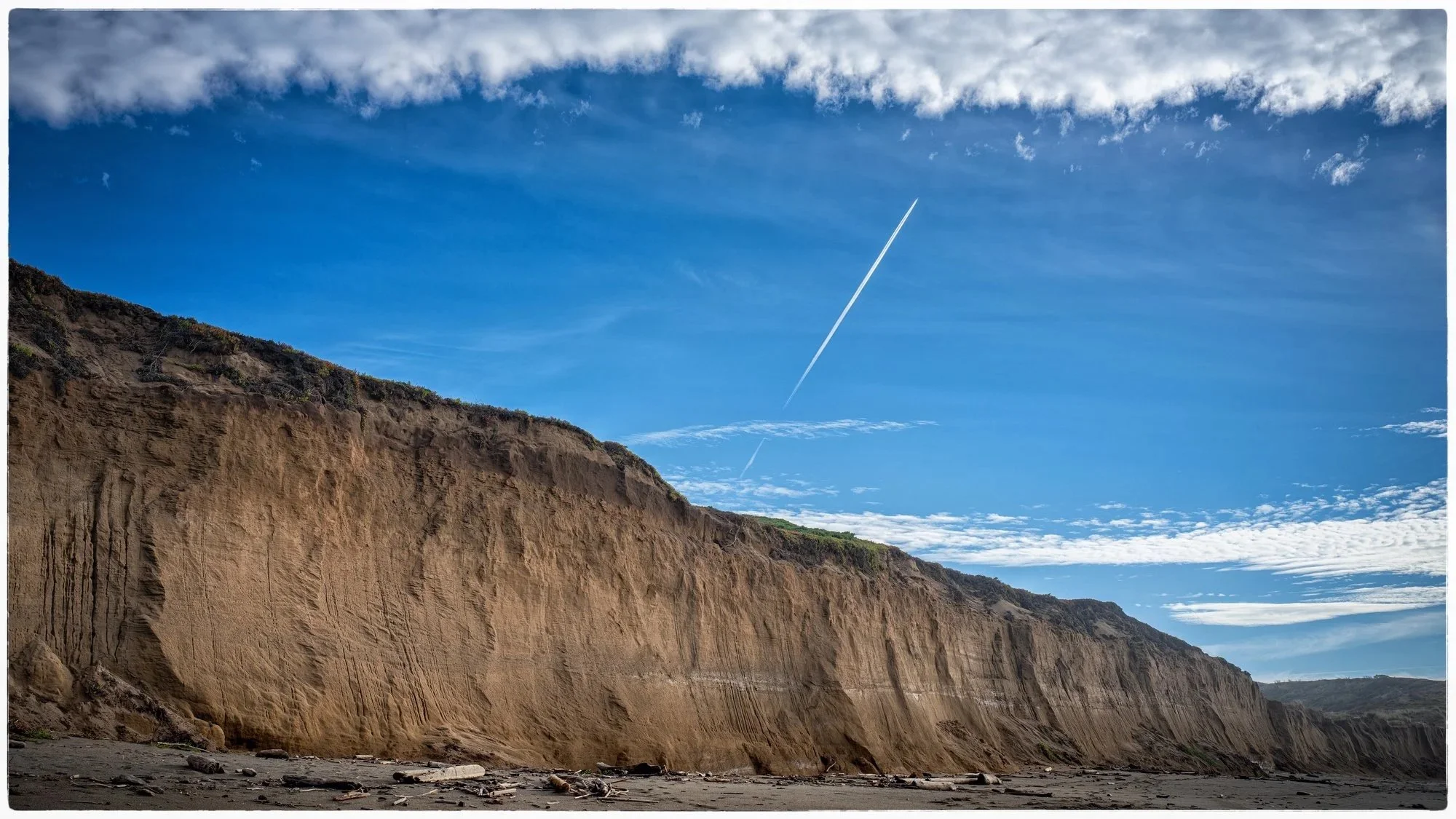
Contrail. Point Reyes. XCDV, f5.6, 1/320 s.
Let me try to explain why.
Handling
The lens weighs almost nothing. Three hundred and fifty grams. On a body the size of the X2D, the whole rig is genuinely portable in a way no other medium format setup I've ever held has managed, with the exception of Fuji GFR, perhaps.
This sounds like a small thing. It isn't. Weight is what determines whether a camera comes with you on the day you weren't sure you were going to shoot. Half of my best images this year were taken on days I almost didn't bring the camera. The 38V is, in a real sense, responsible for those photographs — not because it took them, but because its lightness is what got the camera into the situation where they could be taken.
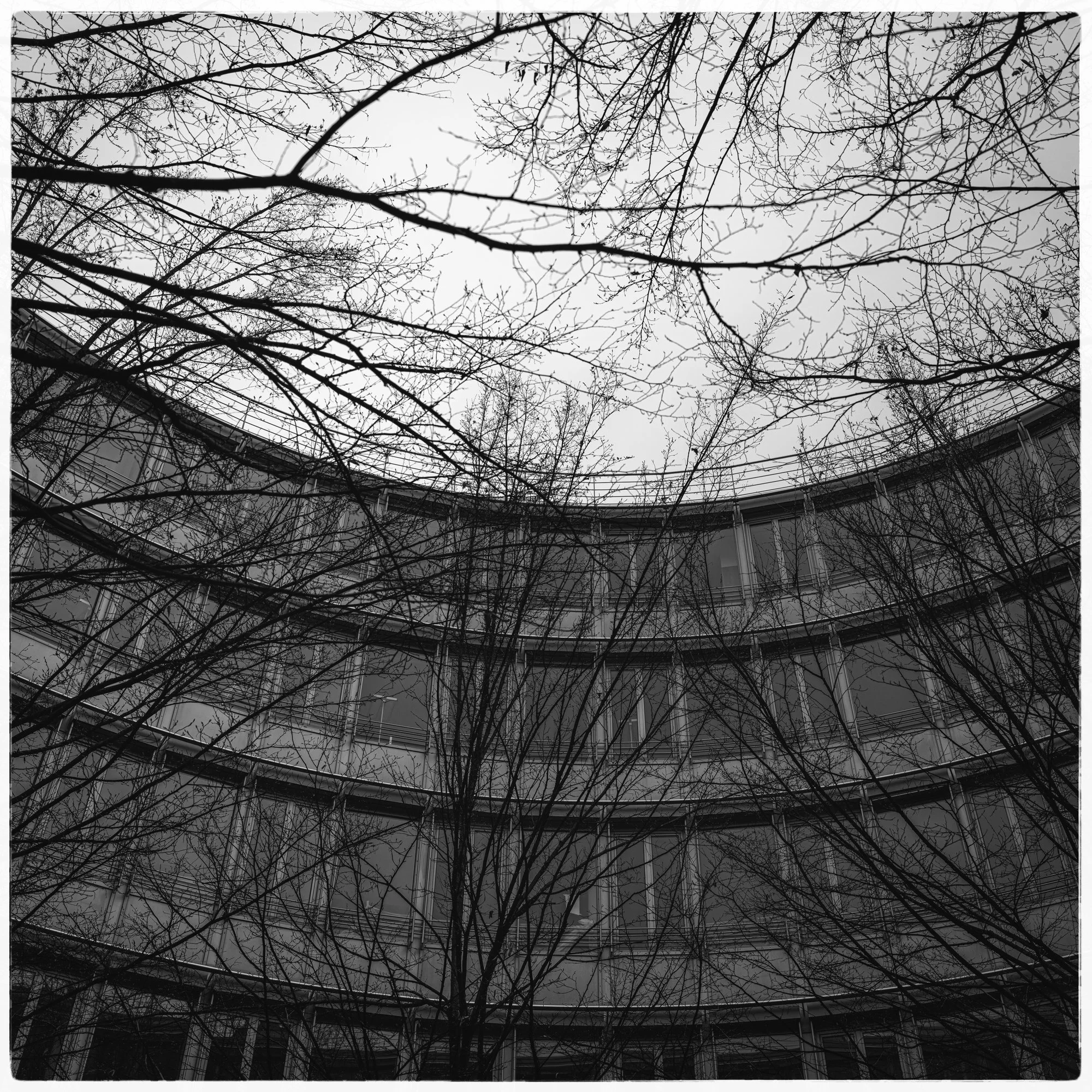
Winter trees. Munich. XCD 38V, f5.6, 1/50 s.
There is a particular feeling to picking up the X2D with the 38V mounted that I have come to recognize as one of the small pleasures of my life. It is balanced. It is solid without being heavy. The metal of the lens body is cold in the morning and warm in the afternoon. The focus ring has a damped resistance that makes you want to use it. The push-pull clutch that switches from autofocus to manual focus moves with the weight of a good door. None of this is necessary for taking pictures. All of it is part of why I take more pictures than I otherwise would.
Seeing with it
This is harder to write about, because the temptation is to make grand claims and the truth is smaller and stranger. The lens has changed my attention. That's the way I can put it. Before the 38V I would walk through a place and notice a few things — a sign, a building, a light. With the 38V mounted I walk through a place and notice almost everything. The frame the lens produces — somewhere between 28 and 35 in full-frame terms, narrow enough to feel like seeing and wide enough to keep context — happens to match the angle of attention I bring to a scene when I'm working well. It's the focal length of looking around a room. It's the focal length of standing in front of a building and taking it in. It's the focal length of memory, more or less — the breadth at which we tend to recall a place after we've left it.
This is what I mean when I say I'm in love with it. I'm in love with it because it sees the way I want to see. There are lenses that produce a particular kind of picture and there are lenses that produce the picture you wanted. The 38V is the second kind. It does not impose. It clarifies.
I own a few Hasselblad lenses and use all of them. But neither of them feels like an extension of my eye in the same way. With the 38V I am not aware of using a lens at all, after the first hour. I am aware of looking at things and pressing a button when something arranges itself.
The 38V is, more than any other lens I've owned, a lens that has made me a better photographer.
I don't say this lightly. I'm aware that the gear-makes-the-photographer claim is mostly nonsense. The work is the work. A good photographer with a poor lens makes better images than a poor photographer with a great lens, and anyone who tells you otherwise is selling something.
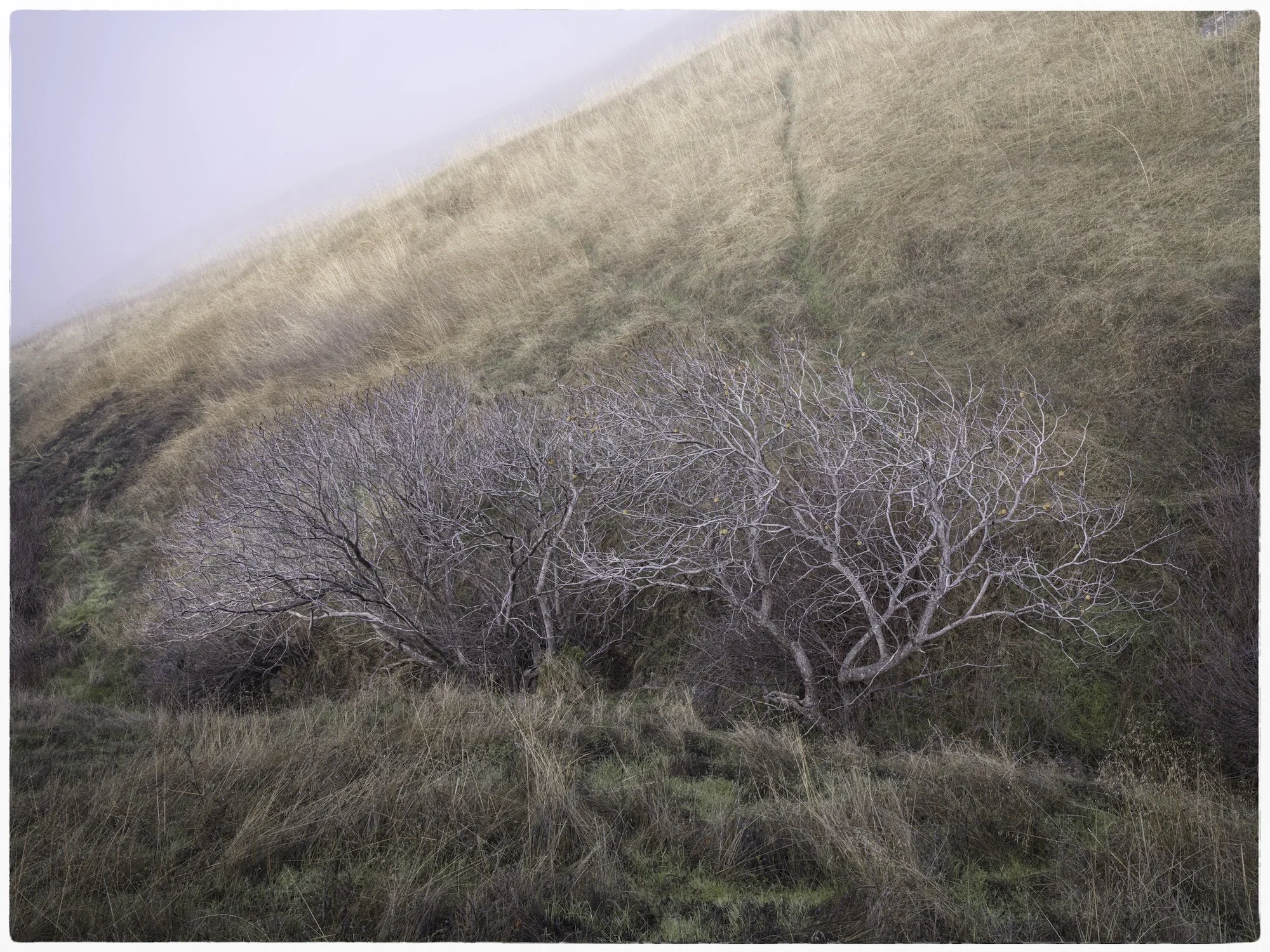
Chestnuts. Mount Diablo. XCD 38V, f13, 1/20 s.
But there is a smaller version of the claim that I think is true. The right tool, in the hands of someone who is paying attention, can change the kind of attention you bring. The 38V has done this for me. The focal length has trained me to look for the relationship between subject and environment, and that habit has migrated into my work with other lenses. The build and the cadence have trained me to commit to frames, and that habit has made me better at seeing pictures before I raise the camera. The rendering has trained me to trust the file, and that trust has freed me to focus on the moment instead of worrying about the technicals.
My mentor, a well known Swedish photographer, has the word saklig — matter-of-fact, restrained, sticking to what is actually there without emotions. He used it once to describe my SDC work, and I have tried to live up to it ever since. The 38V is, I think, a saklig lens. It does not embellish. It does not flatter. It tells you what is there with extraordinary precision and gets out of the way. That precision is something I aspire to in my own seeing, and using the lens has been a small daily lesson in it.
Rendering
I have spent a long time trying to figure out what people mean when they talk about “Hasselblad rendering.” I used to think it was marketing. Now I think it’s real, but mostly indescribable. The closest I can get is this: a flat surface photographed with the 38V has a kind of dimensional presence in the file that I can’t account for. A wall looks like a wall. A pane of glass looks like glass, not like the idea of glass. The transitions between in-focus and out-of-focus areas, the gradient of tone across a face or a building, the way micro-contrast holds in the midtones — all of these feel right in a way that doesn’t draw attention to itself. The image looks like the world. That is supposed to be the easy thing for a camera to do, and almost no camera actually does it.
I will admit there is something a little suspicious about how often Hasselblad owners reach for this kind of language. I know how it sounds. But I’ve shot the same scene with the 38V and with other excellent lenses, and the 38V file is the one I keep coming back to. I don’t know exactly what I’m responding to. I just know that I am.
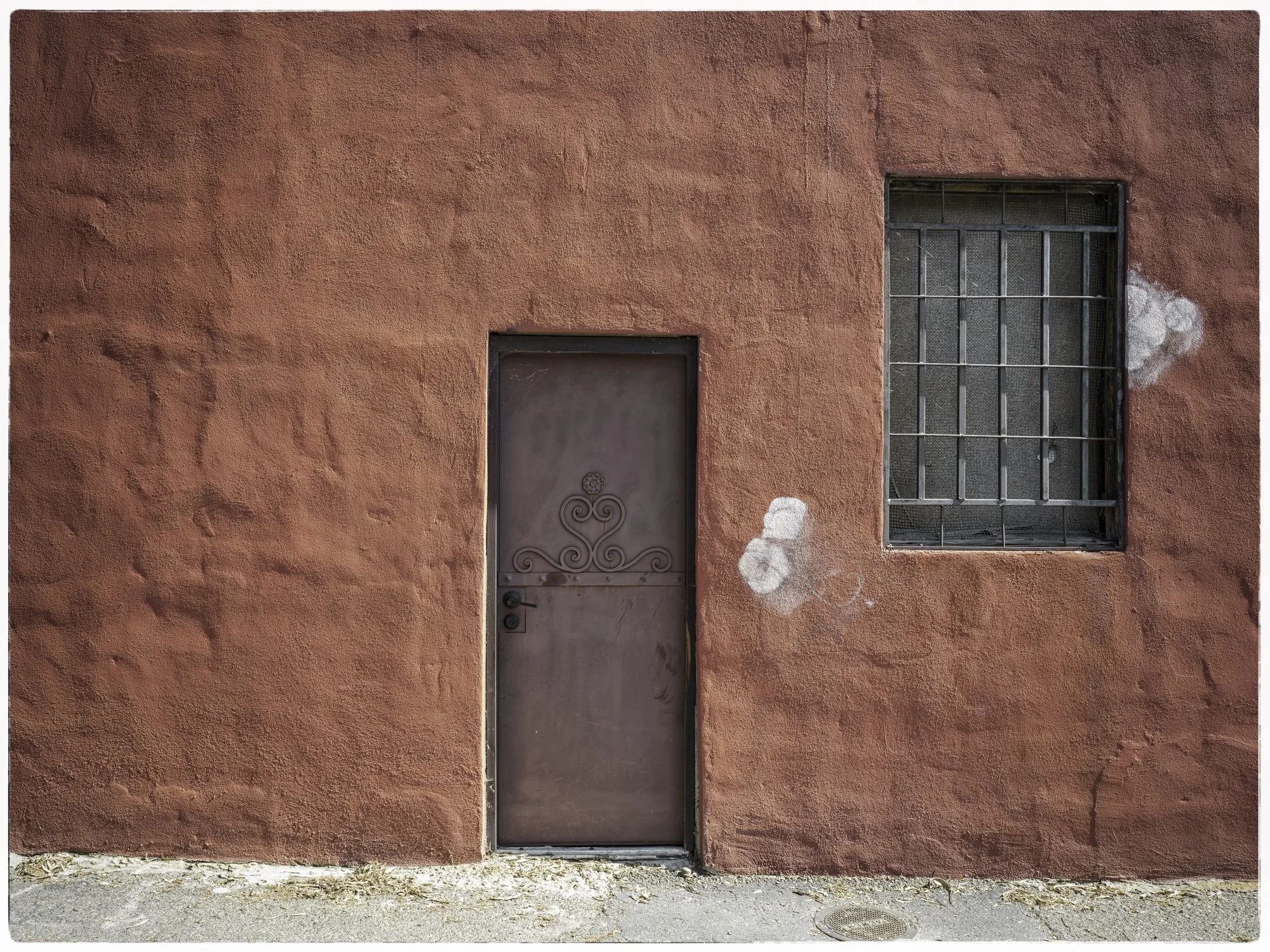
Red wall. Walnut Grove. XCD 38V, f8.0, 1/40 s.
The colors are the other half of this. My color edits on images taken with the XCD 38V are mostly small refinements, never corrections. The lens and the sensor together hand me an image that is already close to what I saw, and editing becomes a matter of attention rather than rescue. Those colors are the colors of my memories. Which brings us to the next section.
Slowing time down
Joseph Brodsky once wrote that the purpose of art is to slow down the perception of time, and I have been thinking about that line for twenty years. Photography is the medium where this question gets asked the most directly — every photograph is, after all, a small theft of a moment from the river — but most photographs don't actually slow time down. They just stop it. There's a difference.
The 38V slows time down. I cannot fully explain why, and I am suspicious of my own claim, but I have noticed it consistently enough that I trust it. Some of this is the camera as a whole — the X2D forces a deliberate cadence, the leaf shutter has a soft mechanical click that feels like a punctuation mark rather than a gunshot, the file size makes you commit to frames rather than spray them. But the lens is part of it too. The focal length is the focal length of careful seeing. The build slows your hands. The weight slows your gait. By the time you've raised the camera, you've already decided what the picture is going to be about.
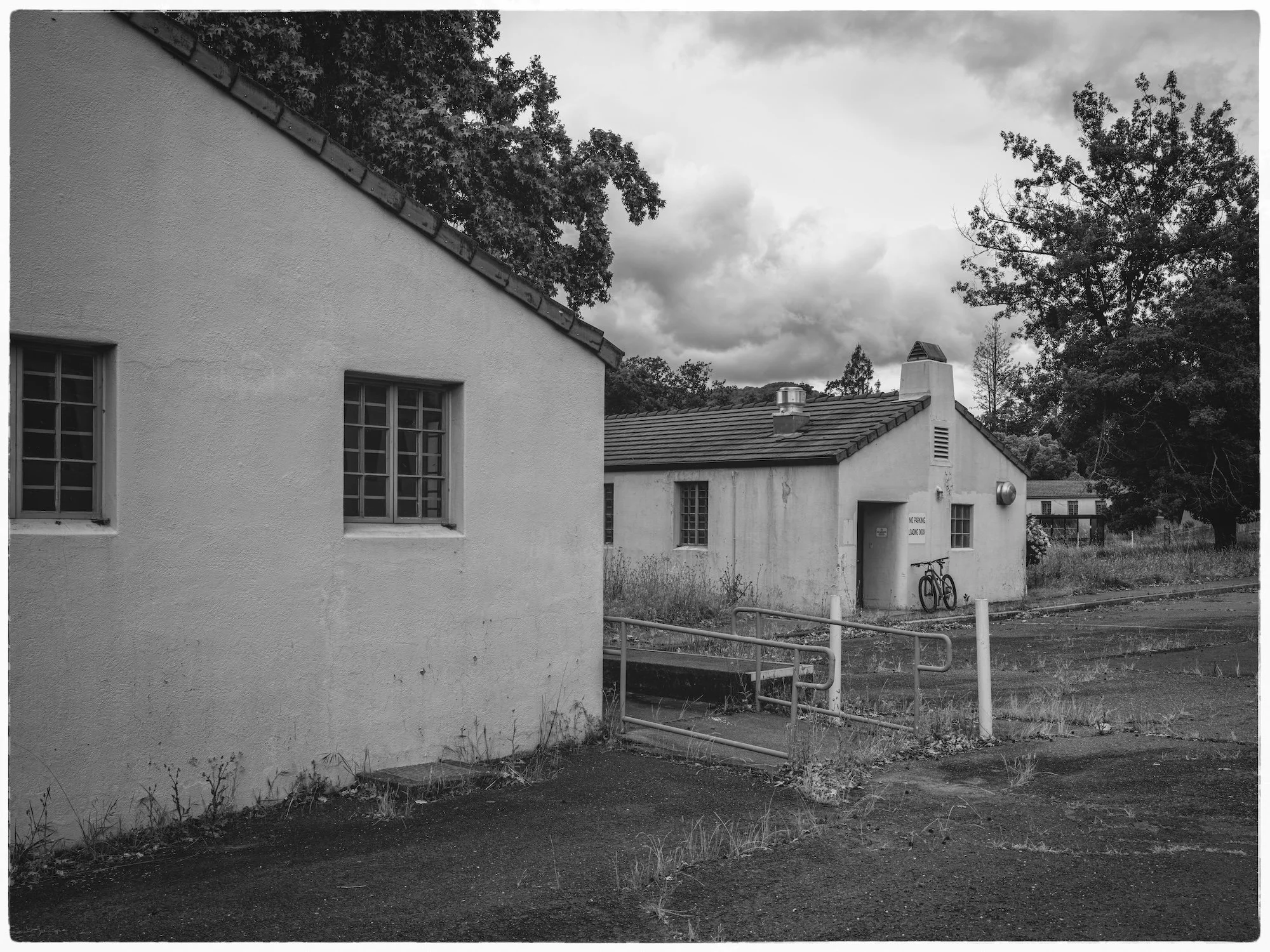
SDC Campus. Sonoma. XCD38V, f8.0, 1/80s.
For the SDC project, where the actual subject is time — the human trace inside a place that has been left to itself, the slow reclamation of an institutional campus by weather and grass and silence — this matters more than I can fairly say. The lens is, somehow, in conversation with the subject. It treats the rooms with the same patience the rooms ask for. I have tried this work with other lenses, including very good ones, and the images don't sit the same way. The 38V is the one that lets the buildings be what they are.
Comparing to the Q3 43
The other lens I love is the Apo-Summicron 43mm on the Leica Q3 43. This is a genuinely extraordinary lens — apochromatic, drawn with the kind of clarity Leica's optical team apparently still knows how to produce when they decide to. It is the closest thing in the small-camera world to what the 38V does on the Hasselblad, and I have lived with both lenses long enough now to have an opinion about how they compare.
The first honest thing I can say is that I cannot reliably tell which one is sharper. When I look at files side by side at full resolution, both lenses resolve everything I need them to resolve, and the differences between them are too small for me to assign with any confidence. They are both excellent. They are both at the edge of what current optics can do.
The fields of view are not the same — the 38V is closer to 30mm equivalent on the X2D's medium format sensor, and the Summicron is a true 43mm on the Q3's full-frame sensor — so direct comparisons are slightly unfair to begin with. Either you compare the same scene shot from the same position (in which case the Summicron crops tighter) or you back up with the Summicron until the framing matches (in which case you have changed the perspective). There is no version of this comparison that is truly clean.
But here is the thing that surprised me. When I crop a 38V frame to a 43mm field of view, the resulting image holds together far better than I expected. The drop in resolution is real but mild — a 100MP file with a moderate crop is still a very large file. More interesting: when I shoot the 28mm Summilux on the original Q3 and crop that to a 43mm field of view, the file falls apart noticeably faster than the 38V file does at the same crop. The medium format starting point is doing real work.
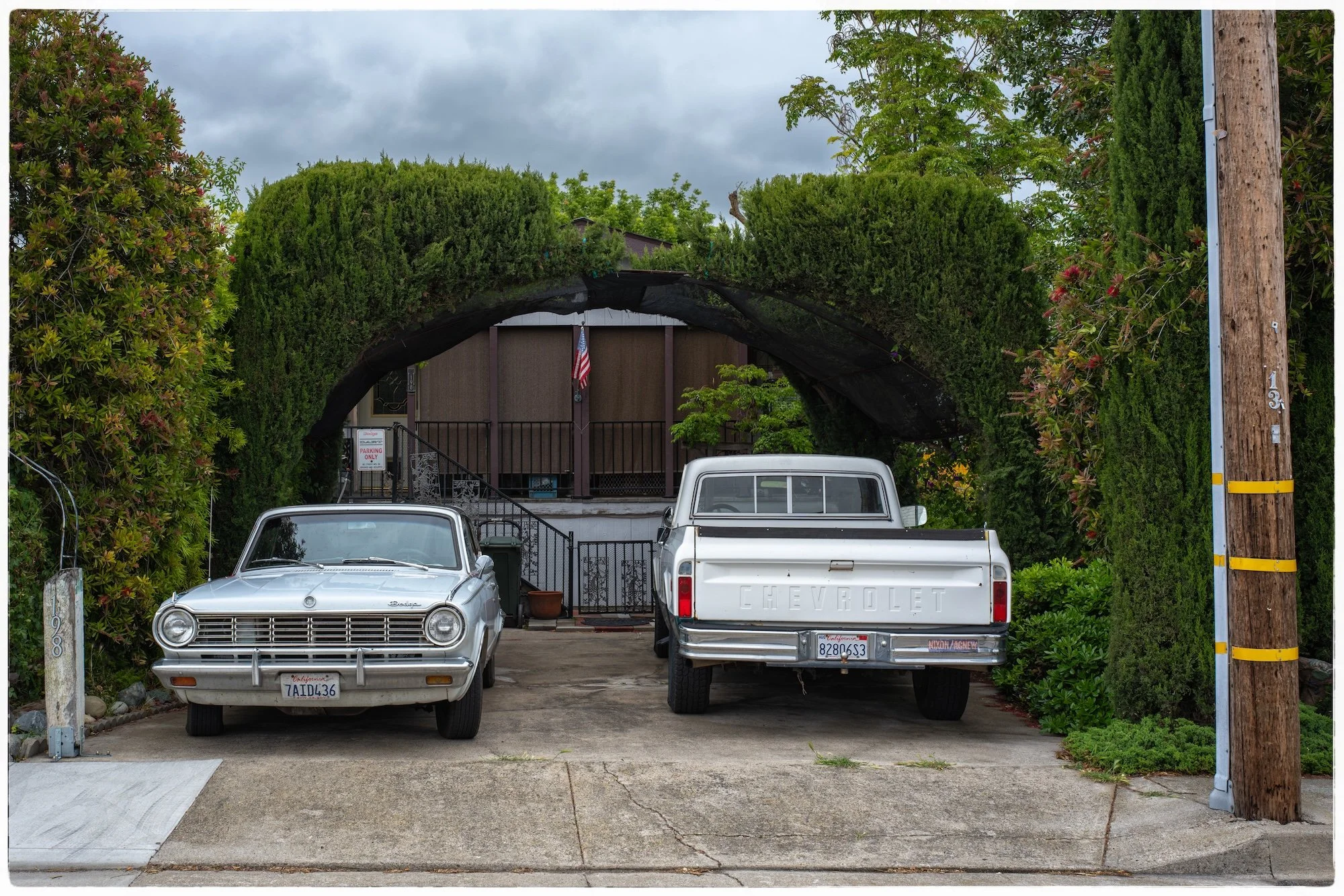
Time travel. Rio Vista. XCD 38V, f9.5, 1/40 s. This and the photo below were taken a few weeks apart. I did not attempt to match FOV.
There is a related observation worth mentioning, because it changed how I think about what the 38V actually is. If you crop a 38V frame to a 24×36mm area — the area of a full-frame sensor — what you have, optically, is a 38mm lens shooting a full-frame frame. Not a 30mm equivalent with medium-format depth-of-field math. A genuine 38mm lens, with the actual physical properties of a 38mm lens: real 38mm depth of field, real 38mm compression, real 38mm rendering. The fact that you got there by cropping a larger frame is a bookkeeping detail.
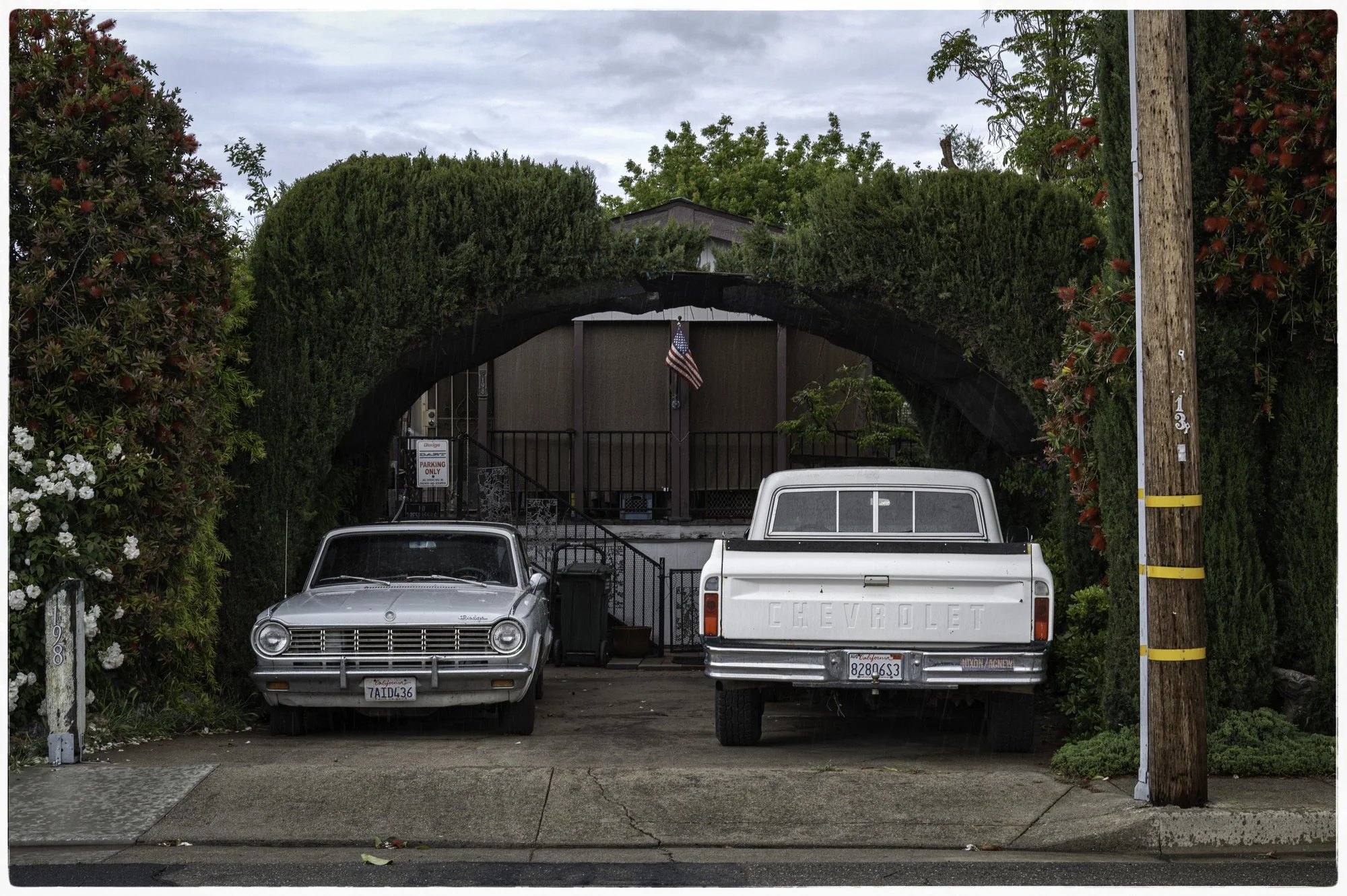
Time travel. Rio Vista. Leica Q3 43, f9.0, 1/100 s.
This means the XCD 38V is, in a real sense, two lenses. Used native, it is a 30mm-equivalent wide-normal on medium format, with the depth-of-field behavior of an f/2.5 medium format lens (roughly equivalent to f/2 on full-frame). Cropped to 2:3, it is a true full-frame 38mm lens, with the rendering of a 38mm prime.
Knowing that the lens has this hidden second identity inside it has, on more than one occasion, made me carry only the X2D and the 38V on a day I might otherwise have brought the Q3.
On croppability
I am not a cropper. I learned to compose in the camera and I have never enjoyed the process of fixing in post what I should have seen in the field. When I do crop, it is almost always to trim — a few pixels off an edge to get rid of a distracting branch or sign I could not avoid at the moment of the shot. I have a personal rule about this, more or less: I crop to clean up, not to recompose.
But there is a separate question, which is whether you can. And with the 38V on the X2D, the answer is yes, to a degree that surprises me every time I look at the math.
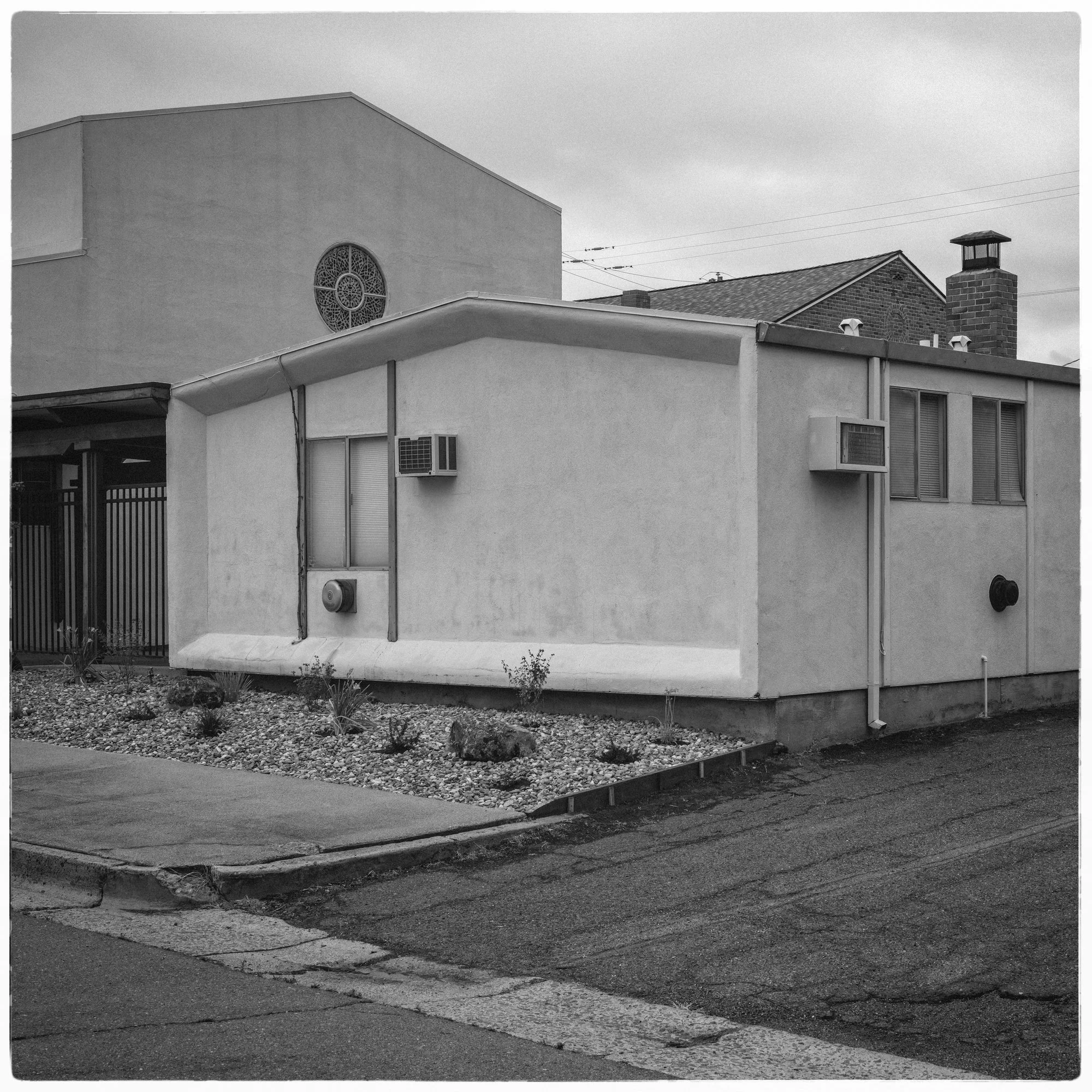
Church. Rio Vista. XCD 38V, f9.5, 1/100s. The image cropped to 33MP. The grain added in post.
The X2D's sensor is 100 megapixels. That is enough resolution that even substantial crops leave you with files other systems would consider native. If I crop a 38V frame to the field of view of a 55mm lens — which works out to a 43mm full-frame equivalent, the same field of view as the Apo Summicron on the Q3 — I am left with about 49 megapixels. That is more resolution than a Nikon Z8 produces at native size. If I crop further, to a 75mm-equivalent field of view, I still have around 26 megapixels, which is more than enough for almost any print I would actually make. Even at a 90mm crop, well into short telephoto territory, the file holds about 18 megapixels — still usable, still printable at meaningful sizes.
No regrets
Do I have any regrets? Actually, very few. The lens vignettes wide open. The corners are visibly darker at f/2.5, and they don’t fully clear up until f/4 or so. Some of my favorite frames embrace this. Most of the time, I correct it in post. It’s easy.
The control ring on the barrel is too easy to bump. Besides, it changes aperture values in the opposite direction from every other lens I have. So I stopped using it. Not a big deal.
The lens is not officially weather-sealed. I’ve shot it in the rain, and it’s been fine. Having official weather sealing would give me some comfort.
Finally, it’s expensive. Most good things are.
The honest thing is that none of these flaws has ever made me want a different lens. I work around them. I have made peace with them. They have become, over time, part of the texture of using this particular instrument: the small frictions that, in a relationship with anything, eventually stop registering as flaws and start registering as features of the thing itself.
Epilogue
The XCD 38V on the X2D II is as close to perfect as a one-camera, one-lens setup can be today. The rendering matches what I want the file to look like. The focal length matches the way I see. It is sharp, it is balanced enough that the camera disappears in my hands. And it is light enough to carry on a long day without thinking about it. None of this is accidental — Hasselblad designed this combination carefully, and I have benefited from that care.
At some point the X system will move on, and a newer lens will come, and I will eventually replace this one. That's how it goes with equipment.
But I will keep this lens after I stop using it. I won't sell it. I'll put it on a shelf and look at it sometimes. Because it is the lens that helped me learn how to see.